
/ From: / Review:77
Since Dr. Charles Kao, a British-Chinese scientist, first proposed the concept of optical fiber in 1966, fiber optics have penetrated nearly all aspects of human society and profoundly transformed people’s lifestyles. With continuous technological advances, the performance requirements for optical fibers have risen sharply. Conventional solid-core glass fibers suffer from inherent material limitations including material absorption, chromatic dispersion, strong nonlinear effects, and low laser-induced damage thresholds. These drawbacks hinder their performance in optical communications, high-power laser delivery, ultrafast optics, nonlinear optics and other disciplines, restraining industrial innovation across related fields.
To break through the bottlenecks of solid-core fibers, researchers have carried out extensive theoretical and experimental explorations, which led to the invention of Hollow-Core Fiber (HCF). HCF features a distinctive waveguide structure: its specially engineered cladding confines optical signals within an air core for light propagation. By fundamentally replacing solid glass with air as the transmission medium, HCF eliminates performance degradation originating from intrinsic material properties of silica, delivering an ideal technical solution to overcome the shortcomings of traditional solid-core fibers.
Hollow-core fibers cover a wide array of structural designs, and researchers have optimized their architectures to pursue superior transmission performance. Research on HCF began with Bragg-cladding hollow-core fibers yet progressed at a sluggish pace for a long time. The proposal of photonic crystal fiber (PCF) in 1996 greatly accelerated the evolution of hollow-core waveguide technology. In 1999, the first photonic bandgap (PBG) hollow-core fiber capable of air-guided light was successfully fabricated, sparking massive follow-up research. Through structural optimization, Kagome-lattice hollow-core fibers were subsequently developed. While sharing partial structural similarities with PBG-PCFs, Kagome fibers do not rely on the photonic bandgap guidance mechanism. Compared with PBG hollow-core fibers, Kagome fibers support simultaneous light transmission across multiple spectral bands and cover a much broader overall wavelength range. In-depth studies on Kagome fibers yielded the anti-resonant reflecting optical waveguide (ARROW) guidance principle, laying the theoretical foundation for anti-resonant hollow-core fibers (AR-HCF).
Discovered during investigations into Kagome structures, anti-resonant hollow-core fibers adopt a much simpler geometry. Studies verify that AR-HCF with negative-curvature core boundaries (the curvature direction of the core wall opposes that of the circular air core) delivers optimal optical performance, and the surrounding tubular cladding array exerts minimal adverse impact on transmission characteristics. For these merits, negative-curvature anti-resonant hollow-core fibers have become the primary research focus in the field.
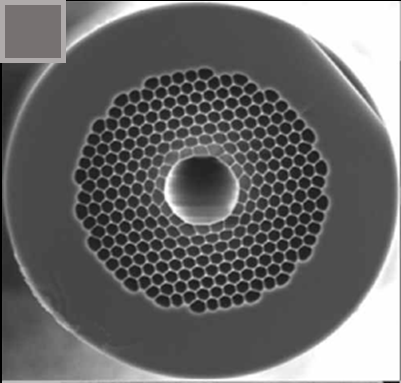
PBG HCF
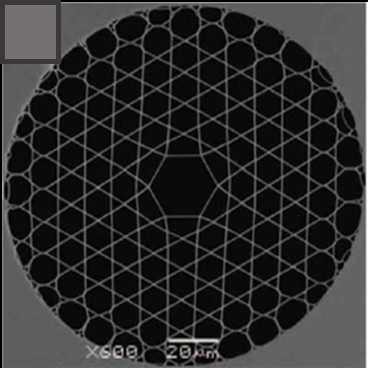
Kagome HCF
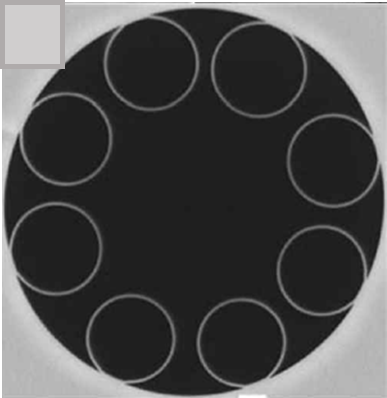
Negative curvature HCF
All hollow-core fiber variants carry unique strengths and inherent tradeoffs. Solid-core fiber, the earliest mature fiber technology with well-established manufacturing processes, has achieved ubiquitous deployment across all industrial sectors. Nevertheless, intrinsic flaws including pronounced nonlinearity, chromatic dispersion and radiation-induced damage impose hard limits on its performance. Amid rapid technological iteration, existing solid-core fiber specifications fail to satisfy growing performance demands, while fundamental material constraints block further performance upgrades. This drives researchers to shift focus to hollow-core fibers, whose air-guided light path drastically suppresses material-originated performance impairments.
The core technical advantages of hollow-core fibers are summarized as follows:
1. Ultra-low signal latency
The propagation velocity of light in a medium follows the formula v=c/n, where higher refractive index n yields slower light speed. Air has a refractive index of nearly 1; therefore, light travels inside HCF at close to the speed of light in vacuum, vastly outperforming silica-based solid-core fibers.
2. Suppressed chromatic dispersion
As light propagates through air instead of glass, material dispersion is drastically reduced. Typically, the material dispersion coefficient of HCF is three orders of magnitude lower than that of solid-core single-mode fibers.
3. Weak nonlinear optical effects
Air possesses an extremely low nonlinear refractive index relative to silica glass, which significantly mitigates detrimental nonlinear optical phenomena during signal transmission.
4. Elevated laser damage threshold
When transmitting high-power laser beams, solid-core fibers absorb optical energy, triggering heat accumulation at material defects or uneven temperature distribution across core-cladding interfaces and eventually inducing irreversible fiber damage. Over 99% of optical power propagates within the air core of HCF, resulting in minimal overlap between the optical field and solid glass cladding. This minimizes material light absorption under identical power levels and delivers a far higher laser-induced damage threshold.
Beyond the above merits, hollow-core fibers also feature low thermal sensitivity, strong radiation resistance and ultra-broad transmission bandwidth, laying a solid foundation for diversified industrial applications.
Based on its superior optical properties, hollow-core fiber finds major applications in the following domains:
The ultra-wide bandwidth and low dispersion of HCF break the capacity ceiling of current fiber communication networks, while its ultra-low latency drastically boosts signal transmission rates. These attributes unlock enormous potential for next-generation optical communication systems, with real-world deployments expanding rapidly in recent years.
HCF’s high damage threshold, excellent beam quality and suppressed nonlinearity make it an ideal medium for high-power laser delivery, covering microfabrication, minimally invasive medical surgery, multiphoton microscopy and other advanced laser applications.
In free-space focused laser beams, light-matter interaction is confined to a tiny focal spot. In contrast, HCF confines high-intensity optical fields within the air core over an extended effective interaction length. This greatly lowers the threshold of light-matter coupling and enhances interaction efficiency.
The hollow core architecture enables flexible functional material infiltration. Researchers can fill the air core with tailored gases, liquids or solid media on demand, creating interdisciplinary bridges between materials science and photonics and greatly broadening the application boundaries of hollow-core fiber technology.
Fiber sensing systems are increasingly deployed in harsh aerospace environments, which demands improved radiation tolerance for optical fibers and components. Hollow-core fiber serves as a leading solution to mitigate signal degradation induced by space ionizing radiation.
With continuous deepening of related research, hollow-core fibers are poised to occupy an increasingly pivotal position in future technological innovation and daily life. Conventional solid-core fibers underpinned decades of information industry advancement; similarly, ongoing breakthroughs in hollow-core fiber R&D will cement its irreplaceable role in the present and upcoming technological revolutions, driven by its unparalleled development potential.

