
/ From: / Review:256
As data centers migrate to 400G/800G networks, traditional fiber cabling struggles to meet high-density demands. MTP/MPO multi-fiber connectors have emerged as the mainstream solution, with cable types like harness cables and trunk cables offering flexible deployment options. Among them, MTP/MPO harness cables break out multi-fiber connectors into simplex or duplex ports, simplifying integration with existing gear. This article outlines how MTP/MPO harness cables work, their benefits, and key use cases.
What Is an MTP/MPO Harness Cable?
MTP/MPO harness cable is a type of fiber optic cable with an MTP/MPO connector on one end and multiple individual or duplex connectors (like LC, FC, SC, or ST) on the other end. This design allows MTP harness cable to efficiently transmit optical signals between data centers and network devices, making it ideal for high-density fiber cabling systems.
What Are the Benefits of Using an MTP to LC Harness Cable?
MTP to LC harness cables demonstrate significant technical advantages in high-density network architectures. Their innovative design enhances connection efficiency and management flexibility within data centers and storage networks. The core benefits include:
1. Port Protection: Harness cables break out trunk cables into multiple LC connectors, reducing frequent plugging and unplugging at core switch ports. This minimizes port wear and the risk of accidental damage.
2. Cabinet Space Saving: Compared to traditional fiber cables, harness cables feature a compact design with smaller diameters for the same fiber count, helping to free up valuable rack space.
3. Reduced Cabling Congestion: Streamlined cable routing improves airflow efficiency and reduces cooling pressure, supporting long-term system stability.
4. Customized Precision: Harness cables can be tailored in terms of breakout length and connector order to match the physical layout of network devices, simplifying complex cabling tasks.
5. Future-Ready Design: Built to international standards, harness cables offer strong backward compatibility and allow for seamless upgrades to higher-speed networks, effectively extending the cabling life cycle.
Applications of MTP/MPO Harness Cables
Harness cables are ideal for short-distance connections within data centers or telecom rooms. They enable flexible connectivity among multiple devices using fewer cables, thereby helping to minimise cable clutter. Harness cables are well-suited for direct connections between switches, servers, or patch panels, providing easy access to ports and making them an excellent choice for local cabling environments.
Direct Connectivity Using an 8-Fiber Harness
When an 8-fiber transceiver needs to be directly connected to four dual-port transceivers, an 8-fiber LC harness cable can be used. This harness is equipped with four LC duplex connectors, with fibers paired in a specific sequence to ensure proper polarity. This type of direct connection is best suited for short-distance links within the same row of racks or cabinets.

|
Item |
Products |
Description |
|
1 |
QSFP Transceiver |
40GBASE-SR4 QSFP+ 850nm 150m DOM MPO-12/UPC MMF Optical Transceiver Module |
|
2 |
MTP/MPO Harnesses |
1m (3ft) MTP Harness, MTP-8 UPC (Female) to 4 LC UPC Duplex, 8 Fibers, Multimode (OM4), Plenum (OFNP), 0.35dB Max, Type B, Magenta |
|
3 |
SFP Transceiver |
10GBASE-SR SFP+ 850nm 300m DOM Duplex LC/UPC MMF Optical Transceiver Module |
Interconnect Using an 8-Fiber Harness
Figure 2 shows an 8-fiber to 2-fiber interconnection structure. One limitation of this solution is reduced flexibility on the SFP+ side. As the LC duplex legs are of equal length, the transceiver ports must be located within the same chassis.
Despite this, it provides a clear and efficient upgrade path from 2-fiber to 8-fiber connectivity. To connect to the SFP+ ports, an 8-fiber LC harness is used as shown in the diagram. On the QSFP side, an 8-fiber MTP trunk cable connects from the MTP adapter panel, allowing a flexible upgrade strategy without replacing the patch panels.

|
Item |
Products |
Description |
|
1 |
QSFP Transceiver |
40GBASE-SR4 QSFP+ 850nm 150m DOM MPO-12/UPC MMF Optical Transceiver Module |
|
2 |
MTP/MPO Jumpers |
1m (3ft) MTP Jumper, MTP-12 UPC (Female) to MTP-12 UPC (Female), 12 Fibers, Multimode (OM4), Plenum (OFNP), 0.35dB Max, Type B, Magenta |
|
3 |
MTP/MPO Fiber Optic Panels |
FHD® Fiber Adapter Panel, OS2/OM3/OM4, MTP-8/12/24 Key Up to Key Down (Black) Adapter |
|
4 |
MTP/MPO Trunks |
30m (98ft) MTP Trunk Cable, MTP-8 UPC (Male) to MTP-8 UPC (Male), 32 Fibers, Multimode (OM4), Plenum (OFNP), 0.20dB Max, Type B, Double Jacket, Magenta |
|
5 |
MTP/MPO Harnesses |
1m (3ft) MTP Harness, MTP-8 UPC (Female) to 4 LC UPC Duplex, 8 Fibers, Multimode (OM4), Plenum (OFNP), 0.35dB Max, Type B, Magenta |
|
6 |
SFP Transceiver |
10GBASE-SR SFP+ 850nm 300m DOM Duplex LC/UPC MMF Optical Transceiver Module |
Duplex Interconnect Using an 8-Fiber Harness
Figure 3 presents a structured cabling interconnect solution that incorporates an 8-fiber harness at one end of the link, forming a duplex fiber path between two SFP transceivers. This setup is particularly effective for high port density switch connections, offering improved cabling efficiency and optimised space utilisation.
The MTP trunk cable connects through an MTP adapter panel to an 8-fiber harness, enabling a smooth MTP to LC transition while maintaining a duplex transmission structure. This design enhances overall network flexibility and simplifies ongoing maintenance.

|
Item |
Products |
Description |
|
1 |
SFP Transceiver |
10GBASE-SR SFP+ 850nm 300m DOM Duplex LC/UPC MMF Optical Transceiver Module |
|
2 |
OM4 Multimode |
1m (3ft) Fiber Patch Cable, 2 Fibers, LC UPC Duplex to LC UPC Duplex, Multimode (OM4), Riser (OFNR), 2.0mm, Tight-Buffered, Aqua |
|
3 |
100G CFP/CFP2/CFP4 |
100GBASE-ER4 CFP 1310nm 40km DOM Duplex LC SMF Optical Transceiver Module |
|
4 |
MTP/MPO Trunks |
30m (98ft) MTP Trunk Cable, MTP-8 UPC (Male) to MTP-8 UPC (Male), 32 Fibers, Multimode (OM4), Plenum (OFNP), 0.20dB Max, Type B, Double Jacket, Magenta |
|
5 |
MTP/MPO Fiber Optic Panels |
FHD® Fiber Adapter Panel, OS2/OM3/OM4, MTP-8/12/24 Key Up to Key Down (Black) Adapter |
|
6 |
MTP/MPO Harnesses |
1m (3ft) MTP Harness, MTP-8 UPC (Female) to 4 LC UPC Duplex, 8 Fibers, Multimode (OM4), Plenum (OFNP), 0.35dB Max, Type B, Magenta |
How to Select the Right LC Leg Length for an MTP to LC Harness?
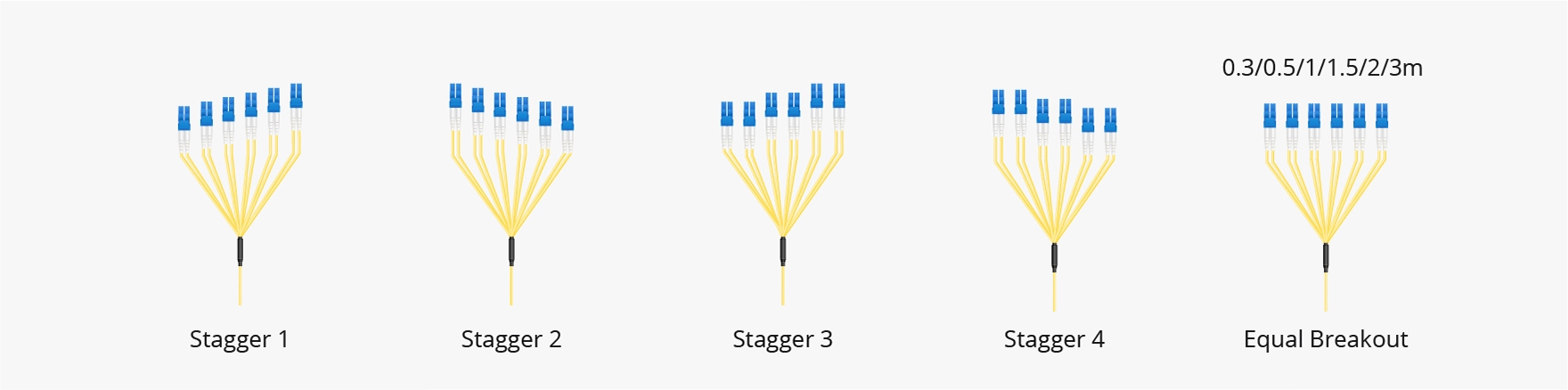
When deploying MTP to LC breakout cables, selecting the appropriate LC leg length depends on the cabling environment, equipment layout, and overall network performance requirements. We offer fully customizable MTP to LC harness cables, supporting flexible length configurations that are ideal for high-density cabling environments. These cables help simplify cable management, minimize signal loss, and enhance overall system reliability.
Our harness cables support fiber counts ranging from 8 to 144 cores. The minimum breakout length for equal-length branches can be as short as 0.3 meters, with additional options including 0.5m, 1m, 1.5m, 2m, and 3m to meet diverse deployment needs. For staggered cabling requirements, We provide four types of staggered configurations, allowing users to fine-tune the length difference between each LC leg in 15mm increments. This helps prevent cable congestion and tangling by adjusting the offset between LC connectors, resulting in a cleaner, more organized rack layout.
Conclusion
As network infrastructure gets faster and more compact, MTP/MPO harness cables are a useful and future-proof option. They are more scalable, quicker to deploy, and use space more efficiently than traditional fiber patch cords. This makes them ideal for data centers and high-performance network environments.

