
/ From: / Review:22
For 400G systems, hyperscale data centers are confronted with the challenge of delivering, scaling, and supporting high-density and ultra-high-bandwidth applications, which demand substantial space to accommodate massive cable harnesses. Low insertion loss, high fiber density, easy installation and stable performance are all essential considerations for next-generation 400G data centers.
For 400 Gb network transmission, the well-known MTP/MPO connector can be adopted as the mating interface, supporting transmission over 32-fiber, 16-fiber or 8-fiber cables. Introduced in 2017, the CS connector delivers a higher-density fiber connectivity solution for 400G deployments.
The CS connector is a new style duplex connector tailored for next generation 400G data centers. While it bears some visual resemblance to the LC duplex connector, it features several distinct characteristics.
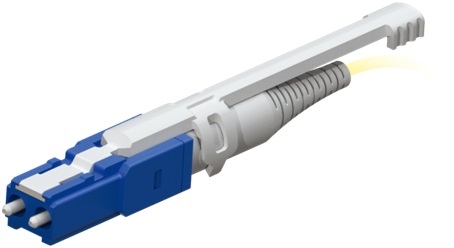
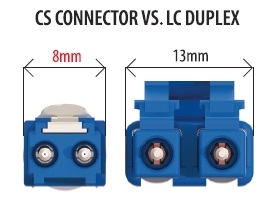
Its most prominent feature lies in its compact form factor. The duplex CS connector measures merely 8 mm across, a 36% reduction compared with the 13 mm dimension of the LC duplex connector, which enables substantially higher cabling density.
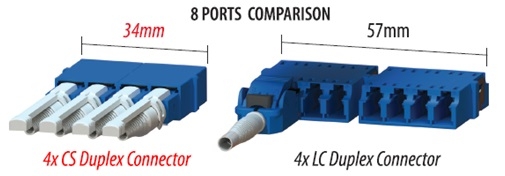
Equipped with a pull-push tab, the CS connector eliminates the need for finger clearance for mating and unmating on adapter panels.
This maximizes adapter port density on panels and further improves cabling density.
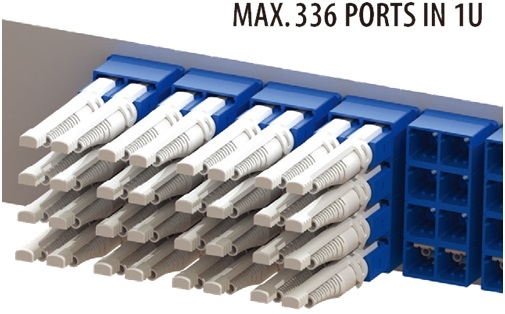
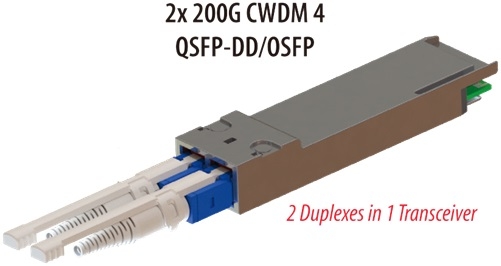
Designed specifically for QSFP-DD (200G/400G) applications, it is also compatible with OSFP (800G) and other form-factors,
ensuring interoperability for future higher-speed 800G transmission.
It employs the widely used 1.25 mm ferrule, offering good general purpose compatibility without significant cost penalties.

